
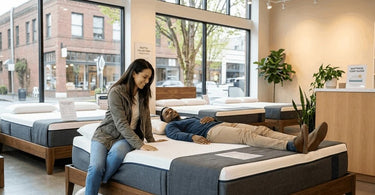
Most mattress pricing guides are written by people who have never actually slept on the mattresses they’re describing. Ours isn’t. At The Drift, our Seattle showroom carries exclusively bed-in-a-box and direct-to-consumer brands — WinkBeds, Helix, Leesa, Bear, Brooklyn Bedding, Nectar, and others — and every single mattress on our floor has been tested by our team in person. When we tell you what a mattress feels like at a given price point, we mean it.
So, how much does a mattress cost?
The short answer: a quality queen-size mattress typically runs between $800 and $2,000 depending on the brand, materials, and construction. Budget options start around $400–$700, while premium models can reach $2,500 or more. But the price tag alone rarely tells the full story. And that’s where shopping in person, at a place like ours in the Belltown neighborhood of Seattle, changes everything.
This guide breaks down mattress costs by type, brand, and budget tier, with the specific context that matters to Seattle shoppers: our climate, our lifestyle, and the specific beds we carry on the floor right now.
Mattress Cost by Type: What You’re Actually Paying For
The biggest driver of mattress price isn’t the brand name, it’s the materials and how they’re constructed. Here’s a clear breakdown of what you can expect to pay for each major mattress type, based on current queen-size pricing at brands we carry.
All-Foam Mattresses: $400–$1,500 (Queen)
All-foam mattresses are typically the most affordable entry point for quality sleep. They use layers of memory foam, polyfoam, or gel-infused foam for pressure relief and motion isolation, which is a huge plus if you sleep with a partner. The trade-off at lower price points is heat retention, though higher-end all-foam options with copper-infused or open-cell foam address this well.
Nectar Classic, one of the best-value all-foam mattresses we carry, comes in around $499–$699 for a queen and includes a 365-night trial and lifetime warranty. It sleeps medium-firm and is particularly well-suited for side sleepers needing pressure relief.
Hybrid Mattresses: $1,000–$2,500+ (Queen)
Hybrid mattresses combine pocketed coil systems with foam or latex comfort layers. They’re the most popular category we sell, and for good reason: they offer the bounce and airflow of innerspring with the pressure relief of foam. In a city like Seattle where mild, damp weather can make temperature regulation feel less urgent than in warmer climates, hybrids strike an excellent balance.
On our floor, hybrid queen prices range from about $1,399 for the Brooklyn Bedding Aurora up to $1,890 for the Bear Elite Hybrid and $3,200+ for Helix Elite models. The difference in that range comes down to coil count, foam quality, and added features like zoned lumbar support or cooling covers.
Latex Mattresses: $1,500–$3,000+ (Queen)
Natural latex mattresses sit at the premium end of the market and for good reason: they’re exceptionally durable, naturally cooling, and responsive in a way foam can’t replicate. They tend to be bouncier and don’t contour as deeply as memory foam. WinkBeds EcoCloud mattress, which we carry, comes in around $1,949 for a queen and is a favorite among eco-conscious sleepers and those with foam sensitivities.
Mattress Price by Budget Tier: What to Expect at Each Level
Budget Tier: $400–$799
At this price point, you’re mostly looking at all-foam options. Construction is simpler, typically two to three foam layers, moderate density, and a 10-year warranty. These mattresses work well for guest rooms, college apartments, or shoppers who simply need a solid night’s sleep without fuss. Expect a lifespan of five to seven years with average use.
What you won’t find at this tier: pocketed coils, luxury covers, advanced cooling technology, or meaningful edge support. That’s not a knock, it’s just an honest picture of what you’re getting.
Mid-Range Tier: $800–$1,499
This is the sweet spot for most Seattle shoppers, and it’s where we’ve found the best value per dollar across everything we carry. In this range, hybrid construction becomes available, coil systems get more sophisticated, and comfort layers start using higher-quality foam with real cooling properties. Warranties extend to 10–15 years, and most brands include generous sleep trials.
Our most-tried mattress in this range is the Brooklyn Bedding Aurora at around $1,399. It's offered in three tailored firmnesses (soft, medium, and firm), and it’s one of the most reliable mattresses we’ve put through its paces.
Premium Tier: $1,500–$2,500
At this level, you’re paying for a meaningful step up in materials, construction quality, and brand confidence. Coil counts increase, comfort layers deepen, and specialty features like Helix Elite's microcoil system, Bear’s Celliant fiber cover, or Nest Bedding's quality latex formulation enter the picture. These mattresses are built to last 10–15 years and are backed by the longest warranties and most comprehensive trials in the industry.
Luxury Tier: $2,500+
Above $2,500, you’re typically paying for natural materials (organic latex, organic cotton, individually-wrapped micro-coils), white-glove delivery, and customization options like split firmness or adjustable bases. These are long-term investments designed to last two decades with proper care.
5 Factors That Drive Mattress Cost (Beyond the Brand Name)
1. Materials and construction. The type and quality of foam, the coil count and gauge, and whether any natural or specialty materials are used are the single biggest price drivers. A hybrid with 800 individually-wrapped pocketed coils and a 3-inch gel memory foam comfort layer will always cost more than a two-layer polyfoam bed - and will perform differently, too.
2. Mattress size. Prices scale with size. A twin queen-size comparison can easily be a 40–60% price difference. Queen is the most popular and most competitive price point; king and California king add $200–$400 to most models.
3. Firmness and specialization. Models engineered for specific sleeper profiles — heavier sleepers, athletes, people with chronic back pain — often cost more because of reinforced construction. The Bear Elite Hybrid, for example, is designed for active recovery and uses Celliant fiber infused into the cover at a price premium over standard hybrids.
4. Trial period and warranty. Longer trials and warranties signal manufacturer confidence and are built into the price. Nectar’s lifetime warranty and 365-night trial is practically unmatched in the industry - and it’s available at a mid-range price. Saatva’s 365-night trial with white-glove delivery comes at a premium but includes in-home setup.
5. Direct-to-consumer vs. traditional retail. This is where shopping at a place like The Drift changes the calculus. Traditional mattress showrooms (you know the ones - big box, aggressive commission salespeople) mark up mattresses by hundreds to thousands of dollars. The brands we carry are all direct-to-consumer priced, which means you’re paying brand-direct prices while still getting to try them in person before you buy.
What Seattle Shoppers Should Know About Mattress Pricing
Seattle’s housing market means a lot of people are spending more time in their apartments and condos than the national average - which is another way of saying that the quality of your sleep setup matters here more than you might expect. Many of our customers in Capitol Hill, Fremont, Ballard, and South Lake Union are buying their first non-dorm mattress, upgrading after years of ignoring the problem, or replacing a mattress that survived one too many moves.
The rainy, temperate Pacific Northwest climate also means that overheating isn’t a crisis-level concern for most Seattle sleepers the way it is in, say, Phoenix. That said, dense foam mattresses can still trap body heat, which is why we’ve seen strong interest in cooling cover and gel-infusion add-ons.
One thing we hear constantly at our showroom, “I didn’t realize how different these all feel until I lay down.” That’s the entire premise of what we do. Online mattress pricing is transparent, but online mattress feel is not.
Don’t Forget These Extra Costs
The sticker price isn’t the total price. Here’s what to factor into your budget when shopping for a new mattress.
Delivery and setup: Most direct-to-consumer brands offer free standard shipping for queen and king mattresses within the contiguous US. White-glove delivery - which includes in-home setup and old mattress removal - is standard with Saatva and available as an add-on with others. Expect $75–$150 for white-glove service on brands that charge separately for it.
Old mattress disposal: Seattle’s mattress recycling infrastructure is reasonably good. King County has drop-off options, and some brands will remove your old mattress as part of delivery. Factor in $150-$225 if you need to arrange separate disposal.
Bed frame and base: Most bed-in-a-box mattresses work on a platform frame, slat system, or adjustable base. If you’re upgrading your mattress and still sleeping on a box spring from 2009, that’s worth addressing. Adjustable bases, which pair particularly well with split-firmness mattresses for couples, start around $600 and go well above $1,500.
Mattress protector: We’d be remiss not to mention this. A quality waterproof protector runs $50–$150, keeps your warranty valid, and extends mattress life significantly. None of the brands we carry require a protector to keep the warranty, but most explicitly recommend one.
When Is It Worth Spending More on a Mattress?
The case for a higher-priced mattress isn’t about luxury, it’s about math. A $1,500 mattress that lasts 12 years costs $125 per year. A $650 mattress that starts sagging in six years costs $108 per year and leaves you sleeping on a compromised surface for the back half of its life. Over a decade, the premium mattress is often the better value.
Spend more if you have chronic back, hip, or shoulder pain. Zoned support systems, better coil quality, and higher-density comfort foams make a material difference for people with pressure sensitivity. We regularly recommend stepping up to the Helix Midnight Elite, WinkBed, or Bear Elite Hybrid for customers who come in specifically mentioning sleep-related pain.
Spend more if you sleep with a partner. Motion isolation and edge support are dramatically better at the $1,200+ tier. The difference between sleeping next to someone on a Nectar Classic and a Nolah Evolution Hybrid is genuinely significant; you can feel it within thirty seconds on both mattresses at our showroom.
Spend less if it’s a guest room, a child’s first big-kid bed, or a short-term solution. There is no reason to put $1,800 into a mattress that will see 20 nights a year of use.
Frequently Asked Questions About Mattress Cost
How much does a good mattress cost in 2026?
A good queen-size mattress in 2025 costs between $800 and $1,800 for most shoppers. Budget options start around $400–$700 and work well for very light use. Mid-range mattresses in the $900–$1,500 range offer the best value. This is where hybrid construction, better materials, and meaningful warranties become available. Premium mattresses above $1,800 offer advanced features like specialty cooling, dual-firmness options, and natural materials.
Is it cheaper to buy a mattress online or in a store?
For traditional retail mattress stores, online is almost always cheaper, sometimes dramatically so, given the high overhead markups at conventional showrooms. But at The Drift in Seattle, you get direct-to-consumer pricing on every mattress we carry, the same prices you’d pay ordering online, with the ability to try each mattress before committing. It’s the reason we exist: direct-to-consumer prices with an in-person experience.
What is the average cost of a queen mattress?
The average price for a queen-size mattress is approximately $1,200–$1,500 across all mattress types in 2025. All-foam queens average around $800–$1,100, hybrid queens average $1,200–$1,800, and latex or specialty grid mattresses average $1,500–$2,200.
How much should I spend on a mattress for a guest room?
For a guest room that sees occasional use, spending $400–$800 on a quality all-foam mattress is more than reasonable. Look for a 10-year warranty, CertiPUR-US certified foam, and at least a 90-night trial. The Nectar Classic at around $499–$699 for a queen is our most common recommendation for this use case. It’s a well-built mattress that won’t leave your guests uncomfortable, without requiring a significant investment.
Do mattress prices go on sale? When is the best time to buy?
Mattress prices go on sale frequently. Most direct-to-consumer brands run 20–35% off sales during major holidays including Memorial Day, Labor Day, Black Friday, and Presidents’ Day. These are real discounts, not manufactured markups. In addition to sales offered by each brand, we offer additional discounts for in-store shoppers at The Drift.
Can you try a mattress before buying at The Drift?
Yes, that’s the whole point! The Drift is Seattle’s only showroom dedicated exclusively to bed-in-a-box and direct-to-consumer mattress brands. You can try DreamCloud, Helix, WinkBed, Nectar, Nolah, Bear, and more in person, at the same prices available online. No commission pressure. No fake mattress collections. Just every mattress we carry, laid out and ready to test.


